GLP-1 medicines and your eyes
Understanding NAION, and when to seek care
Sudden vision loss in one eye needs same-day care. Call an eye doctor right away or go to the emergency department. Don’t wait for your next routine visit.
Medicines like semaglutide (Ozempic, Wegovy, Rybelsus) and tirzepatide (Mounjaro, Zepbound) help many people control blood sugar, lose weight, and, for some patients, protect the heart and kidneys. You may have seen news about a rare eye problem linked to these medicines. This page explains what we know in plain language, so you and your doctors can make a plan that fits you.
What NAION means
NAION (non-arteritic anterior ischemic optic neuropathy) is sometimes called a “stroke” of the optic nerve, the cable that carries signals from your eye to your brain. Blood flow to the front of the nerve drops for a short time, the nerve swells, and part of the vision in one eye can be lost.
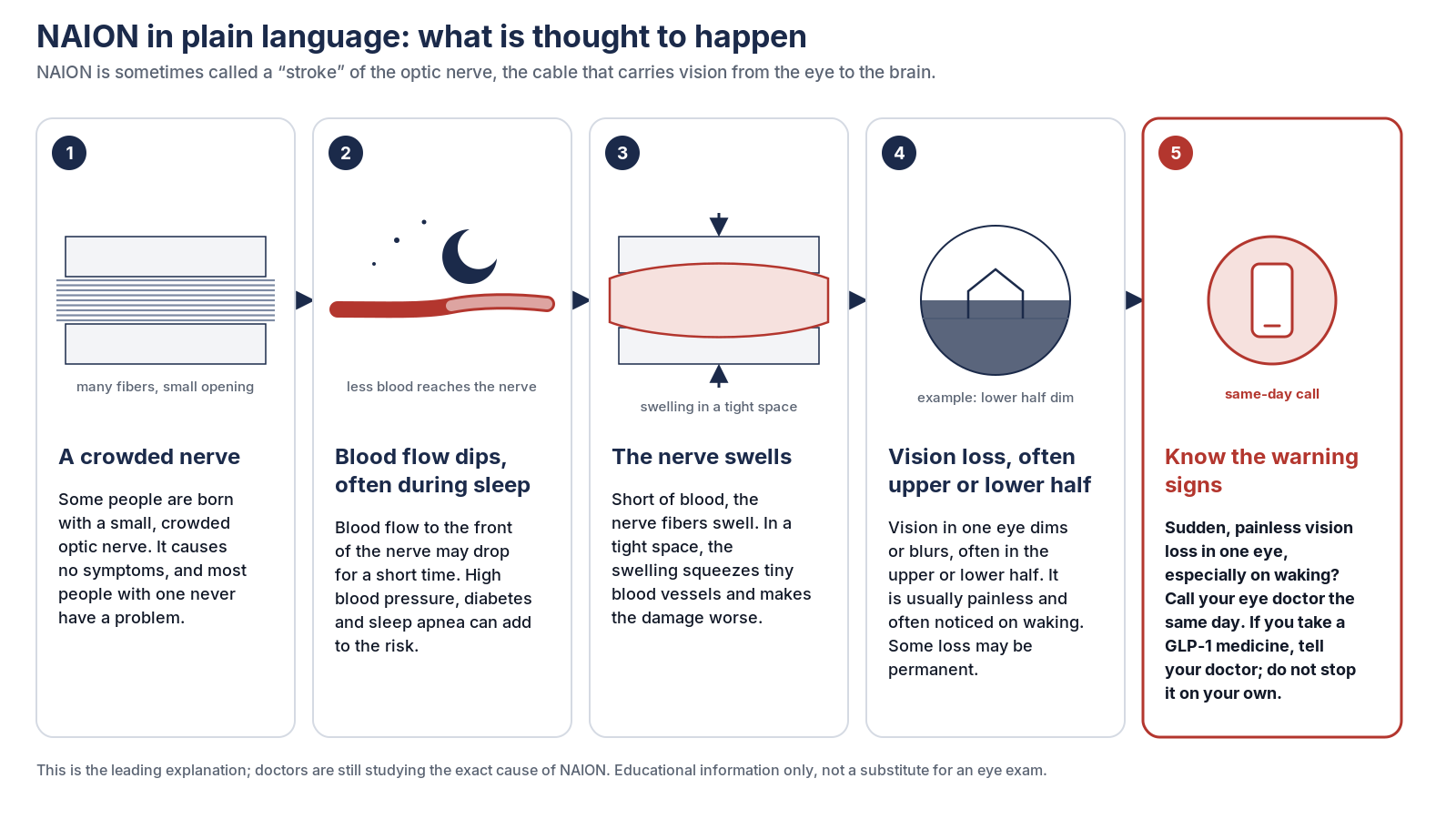
- It is usually painless and is often noticed on waking.
- Vision lost from NAION often does not come back, and there is no proven treatment. That’s why knowing the warning signs matters.
How common is it?
NAION is uncommon. Each year, about 2 to 10 out of every 100,000 adults over 50 develop it.¹ It is more common in people who are older, male, smoke, or have high blood pressure, diabetes, sleep apnea, high cholesterol, anemia, kidney disease, or a naturally small, “crowded” optic nerve.¹ ² You can’t feel a crowded disc; an eye doctor can see it during an exam.
What we know about GLP-1 medicines
- The FDA added a warning. On November 9, 2026, the U.S. Food and Drug Administration required the labels of all GLP-1 medicines to include information about a potential increased risk of NAION. The FDA still describes NAION as rare.¹
- The chance is still very low. One large 2026 review of studies in people with type 2 diabetes estimated about 1 extra case for every 7,000 people taking semaglutide for a year.³ European regulators call NAION a “very rare” side effect of semaglutide, affecting up to 1 in 10,000 people.⁴
- Not every study found a link, and researchers have not proven that the medicine causes NAION. People who take these medicines often already have NAION risk factors, which makes the question hard to study.⁵ A side-by-side comparison of the major studies explains where they agree and where they disagree.
- Most of the research is on semaglutide. The FDA’s warning covers the whole class because NAION has been reported with every GLP-1 medicine, but evidence for each individual drug is less clear.¹
- When it happens is unclear. One large study found a higher risk in the first six months, especially with a big drop in A1c.⁶ Other studies found the risk showing up later.⁷ Any new vision change at any time deserves attention.
For many people, the benefits of these medicines outweigh this small potential eye risk. The right balance depends on your health, and that’s a conversation to have with your doctors.
Your eye care plan
Dr. Deom’s recommendation (his clinical opinion / practice recommendation)
Dr. James Deom recommends that everyone starting or taking a GLP-1 medication have a comprehensive dilated eye exam with OCT, OCT angiography (OCTA), and retinal photography (fundus photos with autofluorescence) as a baseline and for follow-up, and seek same-day care for sudden vision loss.
This is his clinical opinion and practice recommendation. It is not a formal rule from every professional group.
Why he recommends each test — to keep a record, not to predict NAION:
- OCT is a scan that measures the thickness of the nerve-fiber and ganglion-cell layers and shows the shape of the optic nerve, so there is a baseline to compare if vision changes later.
- OCT angiography (OCTA) is a scan that documents blood flow around the optic nerve and in the central retina (the macula), as a baseline record.
- Retinal photographs, including autofluorescence, record how the optic nerve and retina look, including whether the disc is crowded or has drusen, and can show other retinal disease.
These tests have not been shown to predict or prevent NAION. Eye-specialist groups (the American Academy of Ophthalmology and the North American Neuro-Ophthalmology Society) do not recommend an exam only to try to predict NAION, and a normal exam cannot rule out future NAION. Dr. Deom still recommends this exam and imaging as his practice approach so that a baseline exists, other eye conditions can be found, and the appearance of the optic nerve is documented.
Dr. James Deom’s personal clinical thought
This is his opinion, not established evidence. It is not a finding from the studies or a position of the FDA, EMA, AAO, NANOS, or AOA.
As people lose weight and get healthier on GLP-1 medicines, their blood pressure and cholesterol medicines are often not reviewed or adjusted. Blood pressure treatment that is no longer matched to a person’s needs may lead to low blood pressure (hypotension). Low blood pressure can be more pronounced at night and could reduce blood flow to the optic nerve during sleep. That possibility would fit the typical way NAION presents: vision loss noticed on waking.
Dr. Deom recommends that people taking a GLP-1 medicine also work on exercise and diet, and keep regular visits with their usual doctors — even if that doctor did not prescribe the GLP-1 — so the rest of their care, including blood pressure, is maintained. Do not start, stop, or change a blood pressure or cholesterol medicine on your own; talk with the clinician who prescribes it.
What professional groups say
Recommendations are not all the same. A fuller table is on the study comparison page.
| Group | Position (short version) |
|---|---|
| FDA (Nov 9, 2026)¹ | All GLP-1 labels must mention a potential increased risk of rare NAION. Report sudden vision changes right away. After NAION, clinicians should consider stopping the medicine unless the benefits clearly outweigh the risk. |
| European Medicines Agency (June 2025)⁴ | NAION is a “very rare” side effect of semaglutide (up to 1 in 10,000). Semaglutide should be stopped if NAION is confirmed. |
| American Optometric Association (June 2025)⁸ | A comprehensive dilated exam within 12 months before starting, or a baseline exam within one month after. |
| American Academy of Ophthalmology and NANOS (2026)⁵ | Do not recommend a routine exam solely to predict NAION. Keep regular diabetic eye exams. If NAION occurs, use shared decision-making rather than automatically stopping the medicine. |
Dr. Deom’s advice follows the AOA’s timing and goes further by recommending this exam, with OCT, OCTA, and retinal photography, for everyone on these medicines, including for follow-up. He is open about the AAO/NANOS difference, described above.
- If you have diabetes: keep your regular diabetic eye exams, usually yearly or as often as your doctor recommends, in addition to the baseline visit. The American Academy of Ophthalmology also recommends an initial period of closer diabetic-retinopathy monitoring when someone with diabetes starts a GLP-1 medicine, especially if blood sugar has been poorly controlled, because rapid improvement in sugar can temporarily worsen retinopathy in some people.⁹
- If you’ve had NAION before, or your optic nerve looks unusual: talk with both your eye doctor and the clinician who prescribes your medicine about whether it’s right for you, and how often to be seen. Having NAION in one eye raises the risk for the other eye.¹ In a large follow-up study (the Ischemic Optic Neuropathy Decompression Trial), about 15% of people at risk developed NAION in the fellow eye over a median of about five years.¹⁰
Supporting your eye and overall health
- Don’t smoke, or ask for help quitting.
- Keep blood pressure controlled. Tell your doctor if you feel dizzy or lightheaded, especially when standing up or in the morning. As weight changes, ask your usual doctors to review blood pressure and cholesterol medicines (see Dr. Deom’s personal clinical thought above).
- Keep up exercise, diet, and regular visits with your usual doctors, even if someone else prescribed the GLP-1 medicine.
- Get checked for sleep apnea if you snore or are tired during the day. If you have a CPAP, use it.
- Stay hydrated, especially if the medicine causes nausea, vomiting, or diarrhea. If you have a fluid limit for heart or kidney disease, follow that plan.
When to get help immediately
Seek same-day care from an eye doctor or an emergency department if you notice: – Sudden blurry, dim, or hazy vision in one eye – A dark shadow, blank patch, or missing part of your vision (sometimes described as a blind spot or tunnel vision) – Colors looking faded or washed out in one eye
If you are over 50 and also have a new headache, jaw pain when chewing, scalp tenderness, fever, or unexplained weight loss, tell the clinician right away. These can be signs of a different emergency called giant cell arteritis, which needs same-day treatment to protect your vision.
Then contact the clinician who prescribes your medicine for advice. Please don’t stop or change your medicine on your own.
Common questions
Should I stop my GLP-1 medicine? Please don’t stop or change your medicine on your own. For many people these medicines have important benefits for blood sugar, weight, and, in some cases, the heart, kidneys, or sleep apnea. If you have questions, call the clinician who prescribes it — and your eye doctor if you have eye concerns — and decide together.
Can an eye exam prevent NAION? No. A dilated exam with OCT, OCT angiography, and retinal photography cannot reliably predict or prevent NAION. Dr. Deom still recommends that visit so there is a baseline record, other eye disease can be found, and the appearance of the optic nerve is documented.
What should I do if my vision changes suddenly? Seek same-day care from an eye doctor or an emergency department. Then contact the clinician who prescribes your medicine. Don’t wait to see if it clears up on its own.
I’m already on a GLP-1 and I feel fine. Do I still need an exam? Dr. Deom’s practice recommendation is yes: a comprehensive dilated exam with OCT, OCT angiography, and retinal photography as a baseline and for follow-up, even if you have no symptoms. That is his opinion, not a rule from every professional group (see the table above).
We’re here to help
If you’re taking or considering a GLP-1 medicine and have questions about your eyes, our team is happy to help. You can request a comprehensive dilated exam with OCT, OCT angiography, and retinal photography; our offices offer priority scheduling for this visit. All five offices have that imaging set. These images are a record and a way to look for other eye disease. They cannot reliably predict or prevent NAION.
- Hazleton Eye Specialists: 281 Airport Road, Hazle Township, PA 18202 · 570-453-2020
- Stroudsburg Eye Specialists: 2942 Route 611, Suite 5, Tannersville, PA 18372 · 570-421-3342
- Nanticoke Eye Specialists: 233 S. Prospect St., Nanticoke, PA 18634 · 570-735-6000
- Pottsville Eye Specialists: 541 West Bacon Street, Pottsville, PA 17901 · 570-628-3937
- Bangor Eye Specialists: 385 Bangor Junction Rd., Bangor, PA 18013 · 610-588-0129
Medical disclaimer. This page is for general education only. It is not medical advice and does not replace an examination or a conversation with your own doctors. Do not start, stop, or change any medicine without talking to the clinician who prescribes it. If you have sudden vision loss, seek same-day care from an eye doctor or an emergency department. Information is current as of the “last reviewed” date and may change as new research is published.
References
- U.S. FDA. Drug Safety Communication: FDA requires safety labeling changes for GLP-1 RAs due to potential increased risk of NAION. Nov 9, 2026. https://www.fda.gov/drugs/drug-safety-communications/fda-requires-safety-labeling-changes-glucagon-peptide-1-receptor-agonists-glp-1-ras-due-potential
- Liu B, et al. Risk factors for NAION: a large scale meta-analysis. Front Med. 2021. https://www.frontiersin.org/journals/medicine/articles/10.3389/fmed.2021.618353/full
- Chrzanowski J, et al. Semaglutide-associated risk of NAION in type 2 diabetes: systematic review and meta-analysis. PLoS Med. 2026;23(5):e1005064. https://journals.plos.org/plosmedicine/article?id=10.1371/journal.pmed.1005064
- European Medicines Agency (PRAC). NAION a very rare side effect of semaglutide. Jun 6, 2025. https://www.ema.europa.eu/en/news/prac-concludes-eye-condition-naion-very-rare-side-effect-semaglutide-medicines-ozempic-rybelsus-wegovy
- American Academy of Ophthalmology & NANOS. What the data say about GLP-1 drugs and vision loss. Sep 22, 2026. https://www.aao.org/newsroom/news-releases/detail/what-data-say-about-glp-1-drugs-vision-loss
- Noh Y, et al. GLP-1 RAs and risk of NAION in type 2 diabetes. Diabetes Care. 2026;49(5):763-771. https://diabetesjournals.org/care/article/49/5/763/164499/
- Grauslund J, et al. Once-weekly semaglutide and five-year risk of NAION (Denmark). Int J Retina Vitreous. 2024. https://link.springer.com/article/10.1186/s40942-024-00620-x
- American Optometric Association. GLP-1 medications and your vision. https://www.aoa.org/healthy-eyes/caring-for-your-eyes/glp-1-medications-and-your-vision · Clinical report (June 2025): https://www.aoa.org/AOA/Documents/Practice%20Management/Clinical%20Guidelines/AOA%20GLP-1_EBO_clinical-report.pdf
- American Academy of Ophthalmology. Glucagon-like peptide-1 receptor agonists and diabetic retinopathy: a statement from the American Academy of Ophthalmology. November 2026. https://www.aao.org/education/clinical-statement/glucagon-like-peptide-1-receptor-agonists-diabetic
- Newman NJ, et al. The fellow eye in NAION: report from the Ischemic Optic Neuropathy Decompression Trial follow-up study. Am J Ophthalmol. 2002;134:317-328. https://www.ajo.com/article/S0002-9394(02)01639-2/abstract