Comparing the major GLP-1 and NAION studies
Where the research agrees, where it does not, and what professional groups advise
This page places the major published studies of GLP-1 receptor agonists (especially semaglutide) and NAION side by side. Most of this evidence is observational: it can show a link but cannot, by itself, prove that the medicine causes NAION. Study results vary with the population, the comparison medicine, how NAION was identified, and how well other risk factors were accounted for.
Please do not combine these numbers into a personal risk score. Effect sizes are shown only when they were verified from the paper, its abstract, a regulator page, or another source checked for this site. A fuller bibliography is in the master reference list. Related pages: for patients, for prescribers, and for eye doctors.
Sudden vision loss in one eye needs same-day care. Call an eye doctor or go to the emergency department.
How to read the table
- Hazard ratio (HR) or relative risk (RR): how many times higher (or lower) the rate is compared with another group. An HR of 2 means “twice the rate,” but twice a very small number is still small.
- Absolute figures (cases per 100,000 per year, or extra cases per year) are usually more useful for counseling than the relative number alone.
- Not significant (NS) means the confidence interval included no difference, so the study did not demonstrate an increase or decrease.
- A higher relative risk in one study and no increase in another can both be true of their own data. The sections after the tables explain those differences.
Studies reporting a higher risk
| Study | Design / data source | Population | Finding (verified) | Limitations |
|---|---|---|---|---|
| Hathaway et al., JAMA Ophthalmol. 2024⁹ | Retrospective cohort at a neuro-ophthalmology referral practice | Patients prescribed semaglutide vs other medicines for type 2 diabetes or for overweight/obesity | Type 2 diabetes: 36-month cumulative incidence 8.9% vs 1.8%, HR 4.28. Overweight/obesity: HR 7.64 | Referral population is not typical of general practice; estimates are likely inflated. First report; later, larger studies found smaller (or no) increases. |
| Grauslund et al., Int J Retina Vitreous 2024¹⁰ | Nationwide Danish registry cohort | 424,152 people with type 2 diabetes; 106,454 exposed to once-weekly semaglutide | HR 2.19; median time to NAION 22.2 months | Observational; diagnosis codes; residual confounding possible. |
| Danish–Norwegian cohort (Simonsen et al.), Diabetes Obes Metab. 2025¹¹ | New-user, active-comparator registry study | People with type 2 diabetes starting semaglutide vs an SGLT-2 inhibitor | Denmark HR 2.17; pooled HR 2.81; incidence rate difference about +1.41 per 10,000 person-years. Survival curves diverged at about 9 months. | Observational registries; residual confounding; limited to type 2 diabetes. |
| Hsu et al., JAMA Ophthalmol. 2025¹² | Retrospective cohort in TriNetX electronic health records | People with diabetes prescribed semaglutide vs non–GLP-1 RA diabetes medicines | Higher risk at 2 years (HR 2.39, 95% CI 1.37–4.18), 3 years (HR 2.44, 1.44–4.12), and 4 years (HR 2.05, 1.26–3.34). Not reported as significant at earlier time points in the summaries used here. | Same global EHR network used by studies with null results; NAION coding and eye-exam capture are imperfect; surveillance bias possible. |
| McDonald and Fung, JAMA Ophthalmol. 2025¹³ | Retrospective Medicare claims cohort (research letter) | Enrollees aged 65 and older with type 2 diabetes; semaglutide vs other second-line diabetes medicines | Semaglutide HR 1.39 (95% CI 1.13–1.72) | Claims/ICD codes; age 65 and older only; diabetes duration before Medicare enrollment may be incomplete. Exact estimates for other individual agents should be confirmed from the letter itself. |
| JAMA Netw Open 2025¹⁴ | Retrospective matched cohort (TriNetX) | Type 2 diabetes; semaglutide or tirzepatide combined vs other diabetes medicines | HR 1.76 (95% CI 1.01–3.07); 2-year rates 0.04% vs 0.02% | The two medicines were not analyzed separately, so this is not a tirzepatide-only result. Wide interval; lower bound close to 1. |
| Noh et al., Diabetes Care 2026⁷ | UK CPRD cohort, new-user comparison | Type 2 diabetes; GLP-1 RA vs DPP-4 inhibitor | 1-year risk 18.5 vs 7.2 per 100,000; RR 2.56; risk difference 11.3 per 100,000. Highest in the first 6 months; higher with age under 50, male sex, ever-smoking, and an A1c drop of 1% or more. | Observational; UK primary-care data; timing finding has not been consistent across other studies. |
| Ueda et al., Ann Intern Med. 2026³ | Nationwide Swedish cohort | Type 2 diabetes; GLP-1 RA vs SGLT-2 inhibitor | 1-year risk 0.04% vs 0.02% (RR 1.93) in the main analysis | The association attenuated when the analysis was restricted to metformin users, which suggests residual confounding. Important as a caution, not only as a “positive” study. |
Studies reporting no significant increase, mixed results, or a lower risk
| Study | Design / data source | Population | Finding (verified) | Limitations |
|---|---|---|---|---|
| Chou et al., Ophthalmology 2024¹⁵ | Multinational retrospective EHR cohort (160 organizations in 21 countries), propensity-score matched | Type 2 diabetes only (37,314); obesity only (129,690); both (130,216). Semaglutide vs non–GLP-1 glucose-lowering or weight-loss medicines. | No statistically significant association at 1, 2, or 3 years in any of the three groups (for example, type 2 diabetes at 3 years: HR 1.51, 95% CI 0.71–3.25; obesity only at 3 years: HR 0.72, 0.24–2.16; both at 3 years: HR 1.19, 0.78–1.82). | Observational; diagnosis codes; some confidence intervals are wide, so a modest increase is not ruled out, especially in the smaller diabetes-only group. |
| Cai et al. (OHDSI network), JAMA Ophthalmol. 2025¹⁶ | Multinational network of 14 databases; cohort and self-controlled analyses | 810,390 new semaglutide users | Cohort hazard ratios were not significant in 5 of 6 comparisons. HR 2.27 was significant only versus empagliflozin under a specific NAION definition. Self-controlled analysis: incidence rate ratio 1.32. | Database-level results varied. A single significant comparison should not be treated as the headline. One previously circulated comparator-group size could not be verified and is not used here. |
| Abbass et al., Am J Ophthalmol. 2025⁶ | Retrospective matched TriNetX cohort | Type 2 diabetes or high BMI; semaglutide or GLP-1 RAs vs other medicines | No increased risk at the time points studied. In type 2 diabetes on semaglutide, cumulative NAION incidence was 0.039% at 1 year, 0.057% at 3 years, and 0.065% at 5 years. In high BMI, 0.036% at 1 year and 0.038% at 2 years. | Same network limitations as other TriNetX studies (coding, uneven ophthalmology capture, possible surveillance differences). |
| Lieberman et al., Mil Med. 2026¹⁷ | Retrospective cohort in the U.S. Military Health System | 1,212,775 adults (973,529 with type 2 diabetes; 239,246 with overweight or obesity), December 2017–September 2023 | After adjustment, type 2 diabetes with semaglutide: OR 0.36 (95% CI 0.25–0.51) compared with non–GLP-1 RA medicines (a lower observed odds). Overweight/obesity: OR 0.10 (0.01–1.35), not significant. 2,447 NAION events in the cohort. | Unexpected direction of effect; residual confounding, who was selected for semaglutide, and coding limits are important caveats. A military/beneficiary population may not match civilian care. This should not be read as proof that semaglutide protects the optic nerve. Cited by AAO/NANOS among studies that did not show an increased risk. |
| FDA Sentinel analysis, Nov 2026¹ | Retrospective cohort in FDA’s Sentinel commercial network | Adults with type 2 diabetes starting a GLP-1 RA vs a DPP-4 inhibitor or an SGLT-2 inhibitor, 2019–2024 | HR 1.43 (95% CI 1.02–2.01) vs DPP-4 inhibitors (significant). HR 1.19 (0.91–1.54) vs SGLT-2 inhibitors (not significant). Incidence about 26–32 per 100,000 person-years across groups. | Real-world claims; results depend on the comparator. Included here because it is part of the FDA’s own review and is mixed rather than uniformly positive. |
Pooled analyses, meta-analyses, and the FDA trial review
| Study | Design / data source | Population | Finding (verified) | Limitations |
|---|---|---|---|---|
| FDA clinical-trial meta-analysis, Nov 2026¹ | Meta-analysis of 126 randomized trials from GLP-1 RA development programs | 134,253 patients (78,217 on a GLP-1 RA; 56,036 on placebo or a non–GLP-1 glucose-lowering medicine); 288,879 person-years | 15 probable NAION events (10 GLP-1 RA, 5 placebo, 0 on other comparators). Rates: 6.4 vs 3.8 per 100,000 person-years. | Very few events, so estimates are imprecise. Trials were not designed around this outcome and may not reflect routine care. This analysis informed class-wide labeling, not a proven causal mechanism. The FDA reported that animal studies did not identify a mechanism. |
| Chrzanowski et al., PLoS Med. 2026² | Systematic review and meta-analysis (5 studies) | People with type 2 diabetes; mainly semaglutide | HR 2.17; vs SGLT-2 inhibitors 1.96; absolute extra risk about 0.014% per year (about 1 extra case per 7,000 treated patients per year) | GRADE certainty was low. Pooled results inherit the limits of the included observational studies. |
| Dhivagaran et al., Neurology 2026¹⁸ | Bayesian systematic review and meta-analysis | GLP-1 RAs, with a semaglutide focus | Semaglutide RR 2.52; diabetes RR 2.41 | Abstract-level verification; certainty described as low to moderate. An obesity-specific figure circulated elsewhere was not confirmed in the abstract and is not used here. |
| Lampsas et al., Graefes Arch Clin Exp Ophthalmol. 2026¹⁹ | Systematic review and meta-analysis | Type 2 diabetes; semaglutide | HR 3.36 at 1 year; HR 2.37 at 2–5 years | Abstract-level verification; observational input studies; time-stratified results may not match individual cohorts. |
| Ophthalmology meta-analysis, 2026⁸ | Meta-analysis of 6 observational studies | Semaglutide and NAION, including type 2 diabetes and obesity subgroups | Pooled adjusted HR 1.63 (95% CI 0.88–2.39), not statistically significant. Subgroups reported as type 2 diabetes 1.70 and obesity 0.47 in the summaries used for this site. | Certainty described as very low to low; results were sensitive to study choice. Shows how pooling can yield a non-significant result even when some individual studies are positive. |
| Sun et al., Diabetes Obes Metab. 2026²⁰ | Network meta-analysis and safety analysis | Comparative NAION risk among GLP-1 RAs | Abstract: semaglutide HR 1.54; liraglutide HR 1.25 vs non–GLP-1 RA medicines | Full text was not available when this page was prepared. Claims about dulaglutide, exenatide, or tirzepatide from secondary drafts were not verified and are not listed here. |
Where studies agree
- NAION is uncommon. Background rates in adults over 50 are about 2.3–10.2 per 100,000 per year.¹ Even in studies that found a higher relative risk, the absolute number of extra cases is small. One 2026 pooled analysis in type 2 diabetes estimated about 1 extra case per 7,000 people treated with semaglutide for a year.²
- Almost all of the signal comes from observational data, not from trials designed to study NAION. The FDA’s trial review is important, but it rested on only 15 probable events.¹
- A causal relationship has not been established. People prescribed these medicines often already have NAION risk factors (type 2 diabetes, sleep apnea, hypertension, and others). Several authors, and the FDA, treat residual confounding as a central problem.¹ ³
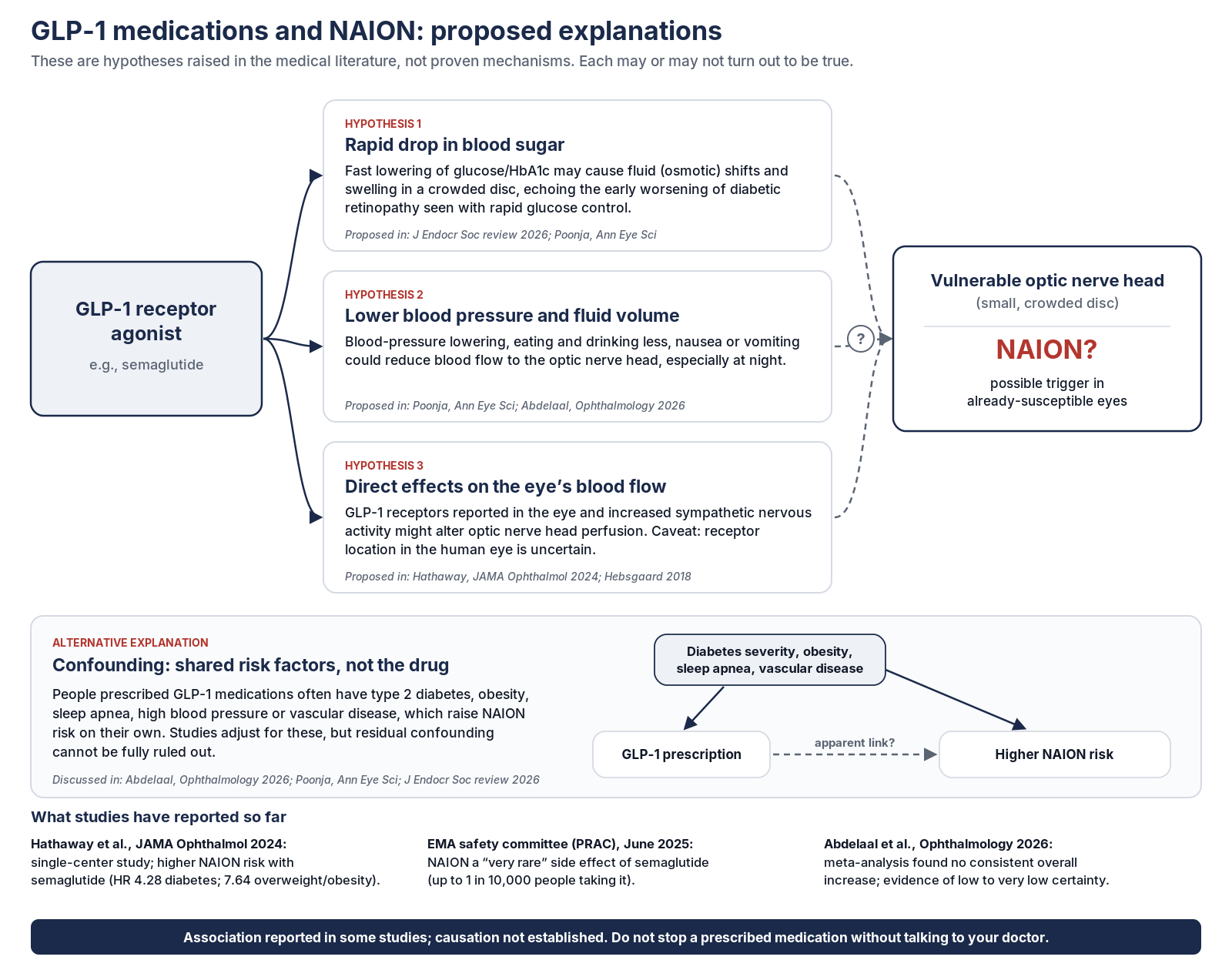
- No mechanism has been proven. The FDA reported that animal data did not identify a mechanism.¹ Proposed ideas (blood pressure or volume changes, rapid A1c lowering, crowded-disc susceptibility) remain hypotheses.
- The most studied medicine and setting is semaglutide in people with type 2 diabetes. That is also where a positive association has been reported most often. Evidence for other agents, and for obesity without diabetes, is thinner.
- Researchers and regulators agree that sudden vision changes need prompt evaluation, and that prior NAION raises the risk of an event in the fellow eye.¹
Where studies disagree
- How large any added risk might be. Verified relative estimates range from no increase (and, in one military cohort, lower odds) to more than a fourfold increase in a specialty referral clinic.⁹ ¹⁵ ¹⁷ National registries and later cohorts more often fall in a roughly twofold range when they find an association,¹⁰ ¹¹ but that is not a uniform result, and one 2026 Ophthalmology meta-analysis was not statistically significant.⁸
- Type 2 diabetes versus obesity without diabetes. Findings in type 2 diabetes are more often positive, though not always.¹⁵ Obesity-only results are less consistent: Hathaway et al. reported a high hazard ratio in a referral cohort,⁹ while Chou et al., the American Journal of Ophthalmology TriNetX analysis, and the Ophthalmology 2026 meta-analysis did not show an increased risk in obesity groups.⁶ ¹⁵ ⁸
- Tirzepatide and other GLP-1 medicines. Most detailed analyses focus on semaglutide. One study of semaglutide or tirzepatide together found HR 1.76; it cannot be read as a tirzepatide-specific result.¹⁴ The FDA applied a class-wide warning because NAION has been reported with every currently marketed GLP-1 RA, including tirzepatide, not because each agent has the same strength of evidence.¹ Agent-by-agent comparisons remain limited; some secondary descriptions of a 2026 network analysis could not be checked against the full text.²⁰
- Causality versus confounding. Ueda et al. found that a positive association weakened when patients with more similar diabetes treatment (metformin users) were compared, which argues that some of the signal may reflect who is prescribed the drug.³ Other investigators judged the association more robust. The FDA concluded there is a potential increased risk and required labeling, while still describing NAION as rare and noting the lack of a demonstrated mechanism.¹
- Timing. This is unsettled. Noh et al. found a higher relative risk in the first six months.⁷ Grauslund et al. reported a median onset of 22.2 months.¹⁰ The Danish–Norwegian curves diverged at about nine months.¹¹ Hsu et al. found a significant increase at two to four years.¹² Different windows can all be reported honestly; they should not be collapsed into a single “highest-risk period.”
What professional groups advise
Professional recommendations are not identical. The table below summarizes official positions. Dr. Deom’s own clinical opinion is described separately after the table, so it is not confused with society guidance.
| Topic | FDA (Nov 9, 2026)¹ | EMA / PRAC (June 2025)²¹ | AAO and NANOS (consensus May 2026; news release Sep 22, 2026)⁴ | AOA (clinical report, June 2025)⁵ |
|---|---|---|---|---|
| Scope | All GLP-1 RAs, including tirzepatide and orforglipron: add a potential increased risk of NAION to Warnings and Precautions | Semaglutide medicines (Ozempic, Rybelsus, Wegovy) | GLP-1 RAs; available evidence is mainly for semaglutide, and the groups advise not assuming the question is limited to that drug | GLP-1 RAs |
| How they describe the risk | Potential increased risk of rare NAION | “Very rare” side effect (up to 1 in 10,000) | A possible small increased risk; causation has not been shown; overall risk remains low | Notes potential sight-threatening complications, including NAION, and calls for baseline and follow-up eye care |
| Baseline or routine eye exam | Not specified as a labeling requirement. Instruct patients to report sudden vision changes immediately and refer suspected NAION promptly. | Not specified as a screening requirement. Seek urgent care for sudden vision loss. | Do not recommend a routine exam solely to assess NAION risk before starting a GLP-1 medicine, because current evidence does not support that practice. Patients with diabetes should continue regularly scheduled diabetic eye exams. | In-person, comprehensive, dilated exam within 12 months before starting, or a baseline exam within 1 month after starting, especially for people with diabetes or AMD. |
| If NAION is diagnosed | Consider discontinuing the GLP-1 RA unless the benefits of treatment clearly outweigh the risk. Patients with prior NAION are at increased risk of recurrence or fellow-eye involvement. | Stop semaglutide if NAION is confirmed. | Shared decision-making with the full care team; they do not support a blanket recommendation to stop for every patient, because stopping can pose substantial health risks for some people. | The AOA clinical report states that if NAION is confirmed, GLP-1 RA treatment should be discontinued and the patient’s health care team consulted immediately. |
| Shared decision-making | Patients who have had NAION should talk with their clinician about whether to continue or stop. | Stop if confirmed (see above). | Emphasized: start, continue, or stop decisions should weigh overall health, alternatives, and fellow-eye risk. | Collaborative care with the clinicians managing diabetes and other systemic conditions. |
All four sources agree that sudden vision changes need prompt evaluation and that patients should not make medication changes on their own without the prescribing clinician.
A separate AAO statement (November 2026) addresses diabetic retinopathy, not NAION: it recommends an initial period of increased retinopathy monitoring when a patient with diabetes starts a GLP-1 RA, especially if baseline A1c has been poorly controlled. The evidence that these medicines themselves worsen retinopathy is mixed and not conclusive.²²
Dr. Deom’s recommendation (clinical opinion / practice recommendation)
The following is the clinical opinion and practice recommendation of James Deom, OD, MPH, FAAO, Chief of Eye Care Services at Eye Specialists of NEPA / Hazleton Eye Specialists. It is not a formal guideline from the FDA, EMA, AAO, NANOS, or AOA, and it should be read alongside the official positions in the table above.
Dr. James Deom recommends that everyone starting or taking a GLP-1 medication have a comprehensive dilated eye exam with OCT, OCT angiography (OCTA), and retinal photography (fundus photos with autofluorescence) as a baseline and for follow-up, and seek same-day care for sudden vision loss.
Why he recommends each test — for documentation, not for prediction:
- OCT: a baseline measure of retinal nerve fiber layer (RNFL) and ganglion-cell layer (GCL) thickness, and of optic disc structure, to compare against if vision changes later.
- OCT angiography (OCTA): a baseline record of peripapillary, optic nerve head, and macular perfusion.
- Fundus photographs with autofluorescence: a baseline record of disc appearance, crowding, possible optic disc drusen, and retinal disease.
These tests do not reliably predict or prevent NAION. AAO and NANOS do not recommend a routine exam solely to predict NAION, and this site does not describe this imaging set as a NAION screening test. Dr. Deom still recommends it as a practice approach so that a baseline exists, other eye disease can be found, and disc anatomy is documented.
His suggested timing, as a practice approach rather than a validated surveillance protocol, is a baseline exam with this imaging set before starting or soon after (a practical window is within 12 months before or 1 month after, consistent with AOA timing), a repeat exam with the same imaging at a reasonable interval individualized to the findings, and a same-day exam for any new visual symptoms. Details are on the monitoring framework page.
This goes further than AAO/NANOS guidance, which does not recommend an exam for people who would be seen only because of GLP-1 use. Patients and clinicians can weigh that difference and still agree on the most important shared point: sudden vision loss is an emergency.
Dr. James Deom’s personal clinical thought
This is his opinion, not established evidence. It is not a finding from the studies or a position of the FDA, EMA, AAO, NANOS, or AOA.
As patients lose weight and their overall health improves on GLP-1 medicines, blood pressure and cholesterol medicines are often not re-addressed. Over-treatment of blood pressure may lead to hypotension, which can worsen at night and could cause nighttime hypoperfusion of the optic nerve. That sequence would fit the typical presentation of NAION (vision loss noticed on waking).
He recommends that people on GLP-1 medicines also improve exercise and diet, and keep regular visits with their usual doctors, even if that clinician did not prescribe the GLP-1, so the rest of their care, including blood pressure, is maintained.
For prescribers: consider reviewing antihypertensive dosing and timing (including bedtime dosing) as weight drops. Coordinate changes with the patient’s usual clinician when someone else wrote the GLP-1 prescription.
Imaging at Eye Specialists of NEPA
All five offices — Hazleton, Stroudsburg, Nanticoke, Pottsville, and Bangor — have OCT, OCT angiography (OCTA), and fundus photography with autofluorescence, the imaging set in Dr. Deom’s recommendation above. These tools help document optic nerve and retinal structure. They are not a test that can reliably predict or prevent NAION.
Patients and referring clinicians can find locations at drkislan.com/our-locations.
Medical disclaimer. This page is for education. It is not a clinical practice guideline and does not replace examination, product labeling, or a conversation with a patient’s own clinicians. Do not start, stop, or change a medicine without the prescribing clinician. If sudden vision loss occurs, seek same-day care from an eye doctor or an emergency department. Information is current as of the “last reviewed” date and may change as new research is published. Recommendations from regulators and professional societies differ and continue to evolve.
References
- U.S. FDA. Drug Safety Communication: FDA requires safety labeling changes for GLP-1 RAs due to potential increased risk of NAION. Nov 9, 2026. https://www.fda.gov/drugs/drug-safety-communications/fda-requires-safety-labeling-changes-glucagon-peptide-1-receptor-agonists-glp-1-ras-due-potential
- Chrzanowski J, et al. Semaglutide-associated risk of NAION in type 2 diabetes: systematic review and meta-analysis. PLoS Med. 2026;23(5):e1005064. https://journals.plos.org/plosmedicine/article?id=10.1371/journal.pmed.1005064
- Ueda P, et al. GLP-1 RAs and risk for anterior ischemic optic neuropathy: a nationwide cohort study. Ann Intern Med. 2026;179(9):1232-1243. https://www.acpjournals.org/doi/10.7326/ANNALS-25-02096
- American Academy of Ophthalmology and NANOS. Consensus statement (May 2026): https://www.aao.org/education/clinical-statement/glucagon-like-peptide-1-receptor-agonists-risk-of- · News release, Sep 22, 2026: https://www.aao.org/newsroom/news-releases/detail/what-data-say-about-glp-1-drugs-vision-loss
- American Optometric Association. Clinical report: GLP-1 receptor agonists (Evidence-Based Optometry), June 2025. https://www.aoa.org/AOA/Documents/Practice%20Management/Clinical%20Guidelines/AOA%20GLP-1_EBO_clinical-report.pdf · Patient page: https://www.aoa.org/healthy-eyes/caring-for-your-eyes/glp-1-medications-and-your-vision
- Abbass NJ, et al. The effect of semaglutide and GLP-1 RAs on risk of NAION. Am J Ophthalmol. 2025. https://www.ajo.com/article/S0002-9394(25)00094-7/fulltext
- Noh Y, et al. GLP-1 RAs and risk of NAION in type 2 diabetes. Diabetes Care. 2026;49(5):763-771. https://diabetesjournals.org/care/article/49/5/763/164499/
- Semaglutide and the risk of NAION: meta-analysis. Ophthalmology. 2026. https://www.aaojournal.org/article/S0161-6420(26)00082-5/fulltext
- Hathaway JT, et al. Risk of NAION in patients prescribed semaglutide. JAMA Ophthalmol. 2024;142(8):732-739. https://jamanetwork.com/journals/jamaophthalmology/fullarticle/2820255
- Grauslund J, et al. Once-weekly semaglutide and five-year risk of NAION (Denmark). Int J Retina Vitreous. 2024. https://link.springer.com/article/10.1186/s40942-024-00620-x
- Simonsen et al. Use of semaglutide and risk of NAION: a Danish–Norwegian cohort study. Diabetes Obes Metab. 2025;27(6):3094-3103. https://pubmed.ncbi.nlm.nih.gov/40098249/
- Hsu AY, et al. Semaglutide and NAION risk among patients with diabetes. JAMA Ophthalmol. 2025. https://jamanetwork.com/journals/jamaophthalmology/fullarticle/2831924
- McDonald CJ, Fung KW. GLP-1 RAs and risk of NAION in older patients with diabetes. JAMA Ophthalmol. 2025. https://jamanetwork.com/journals/jamaophthalmology/fullarticle/2836771
- Semaglutide or tirzepatide and optic nerve disorders in type 2 diabetes. JAMA Netw Open. 2025. https://jamanetwork.com/journals/jamanetworkopen/fullarticle/2837377
- Chou CC, et al. Association between semaglutide and NAION: a multinational population-based study. Ophthalmology. 2024. doi:10.1016/j.ophtha.2024.10.030. https://www.aaojournal.org/article/S0161-6420(24)00685-7/fulltext
- Cai CX, et al. Semaglutide and NAION (OHDSI network). JAMA Ophthalmol. 2025. https://jamanetwork.com/journals/jamaophthalmology/fullarticle/2830475
- Lieberman RA, Korona-Bailey J, Banaag A, Furhman B, Corrado R, Koehlmoos TP. Semaglutide and NAION in type 2 diabetic patients. Mil Med. 2026;191(5-6):e1020. doi:10.1093/milmed/usaf522. https://academic.oup.com/milmed/article/191/5-6/e1020/8320596
- Dhivagaran T, et al. GLP-1 RAs and risk of NAION: systematic review and meta-analysis. Neurology. 2026;106(10):e214864. https://www.neurology.org/doi/10.1212/WNL.0000000000214864
- Lampsas S, et al. Semaglutide and risk of NAION in type 2 diabetes: systematic review and meta-analysis. Graefes Arch Clin Exp Ophthalmol. 2026. doi:10.1007/s00417-026-07291-4
- Sun et al. Comparative risk of NAION among GLP-1 RAs. Diabetes Obes Metab. 2026. doi:10.1111/dom.71358. https://dom-pubs.onlinelibrary.wiley.com/doi/10.1111/dom.71358
- EMA PRAC. NAION is a very rare side effect of semaglutide medicines. Jun 6, 2025 (revised Jun 13, 2025). https://www.ema.europa.eu/en/news/prac-concludes-eye-condition-naion-very-rare-side-effect-semaglutide-medicines-ozempic-rybelsus-wegovy
- American Academy of Ophthalmology. GLP-1 receptor agonists and diabetic retinopathy: a statement from the American Academy of Ophthalmology. November 2026. https://www.aao.org/education/clinical-statement/glucagon-like-peptide-1-receptor-agonists-diabetic