GLP-1 RAs and NAION: a clinical reference for eye doctors
Educational summary. This is not a practice guideline. Individualize to each patient’s findings and history.
Clinical summary
Observational data show a relative-risk signal for NAION, strongest for semaglutide, but the estimates vary widely across populations, comparators, and case definitions, and residual confounding remains important.² ³ A pooled observational estimate in T2D is about 1 excess case per 7,000 semaglutide-treated patients per year (Chrzanowski, PLoS Med 2026).² That figure should not be applied to every GLP-1 RA or every patient.
On Nov 9, 2026, the FDA required a class-wide Warnings and Precautions label change for a potential increased risk of NAION. Its pooled analysis of 126 RCTs found 6.4 vs 3.8 cases per 100,000 PY.¹ The class includes exenatide, liraglutide, dulaglutide, lixisenatide combinations, semaglutide, tirzepatide, and orforglipron.¹
Disease basics (refresher)
- Most common acute optic neuropathy over 50: painless monocular loss, often on waking; RAPD; altitudinal or arcuate defect; diffuse or segmental disc edema, often with peripapillary hemorrhages; pallor at about 4–6 weeks.⁴ ⁵
- Main anatomic risk factor is the disc at risk (small or absent cup). Drusen also predispose. Absence of a disc at risk (in the fellow eye) should prompt consideration of arteritic AION or another diagnosis.⁴
- Always consider GCA in patients over 50 (symptoms, ESR, CRP, CBC with platelets).
- NAION is a small-vessel hypoperfusion event, not embolic. Carotid imaging is not routinely indicated.⁴
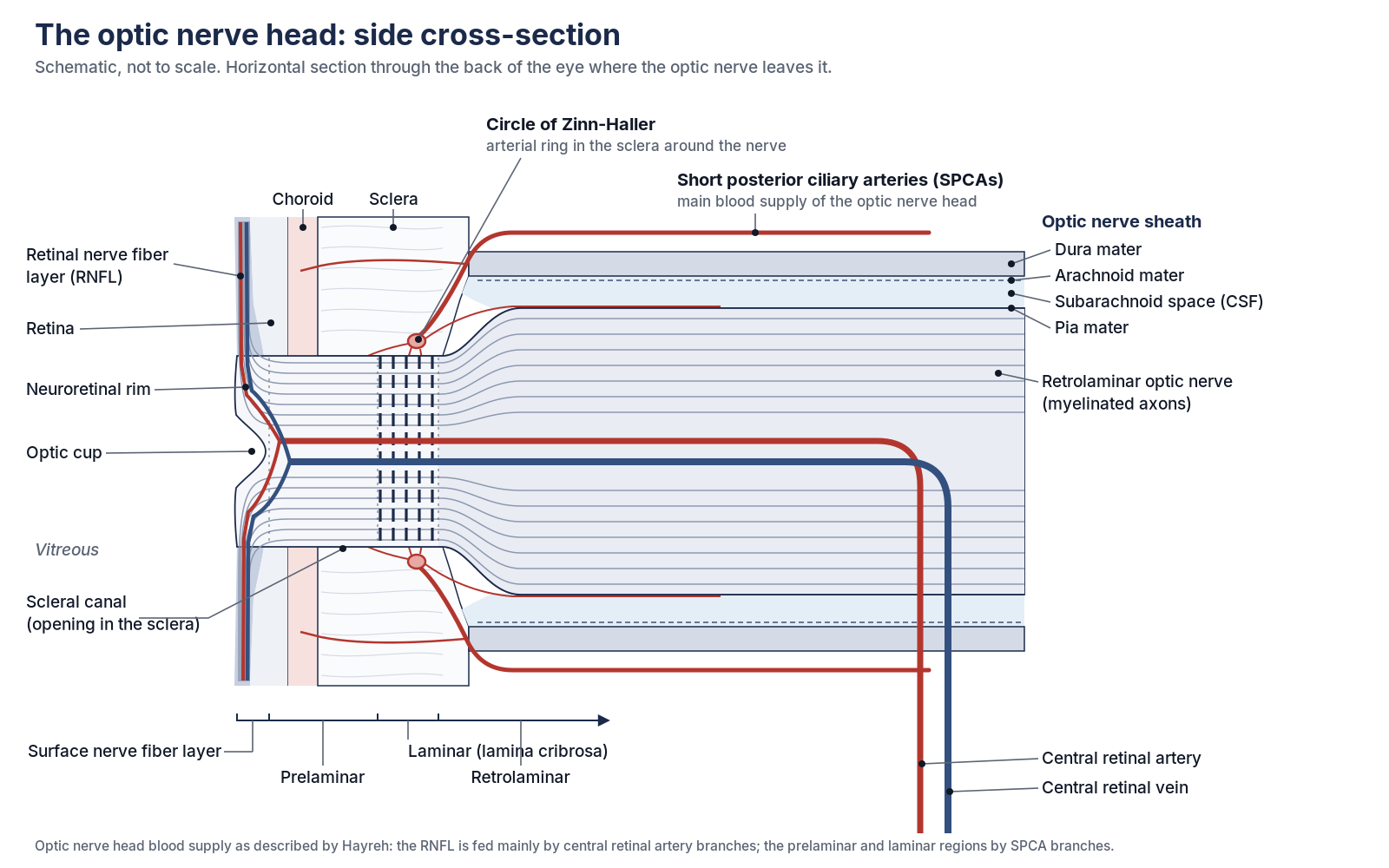
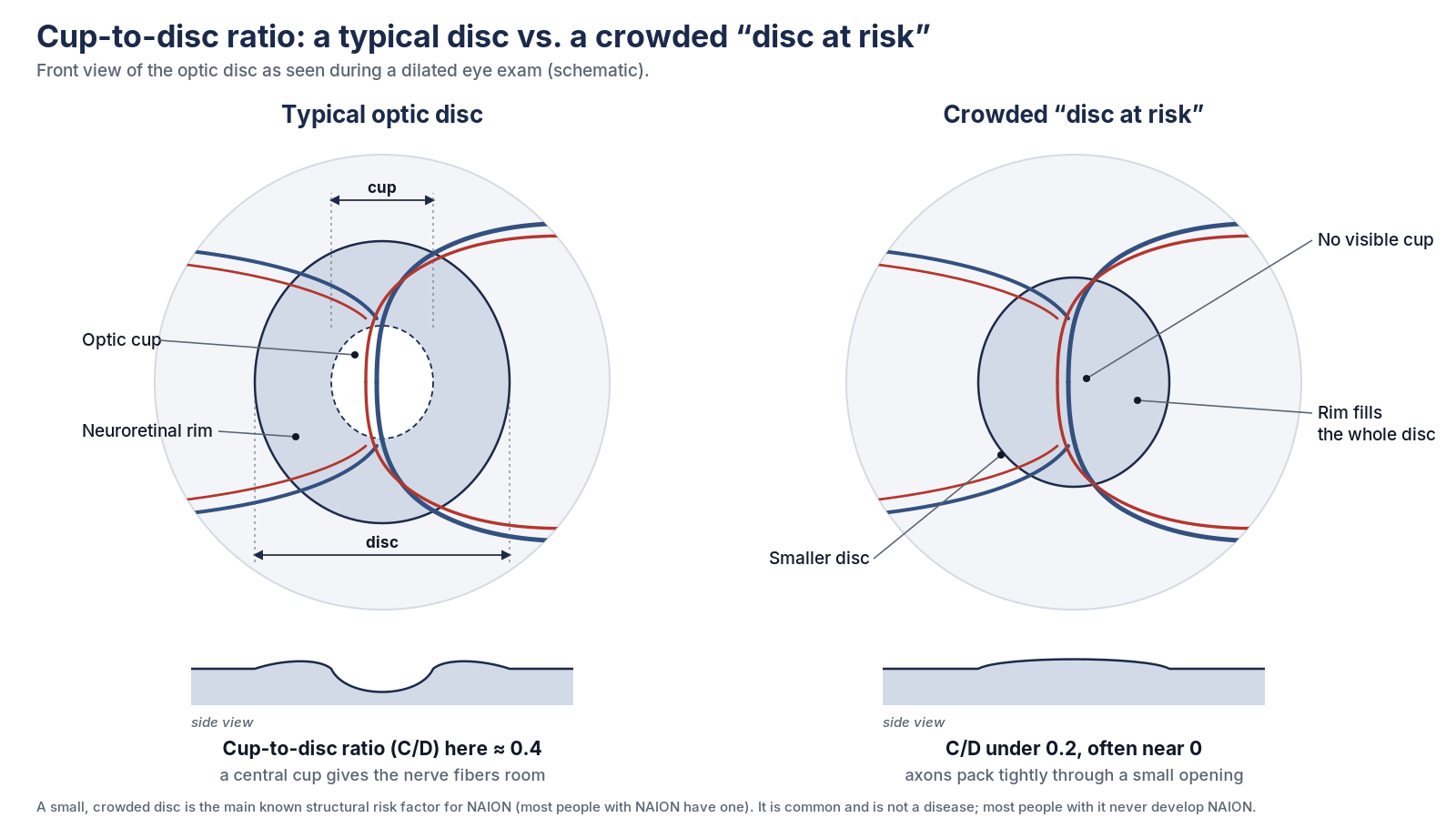
Cup-to-disc ratio compares the width of the central cup with the width of the whole disc. A small, crowded disc with little or no cup is the main known structural risk factor for NAION. It is common, and most people who have one never develop NAION. Schematic, not to scale. – Risk factors (Cestari, Ophthalmology 2016, U.S. claims cohort):⁶ age (HR 1.02/yr), female sex (HR 0.64), hypertension (1.62), hypercoagulable state (2.46), complicated vs uncomplicated DM (1.27), RVO (3.94), AMD (1.29). Also OSA (about 3–4×),⁷ ⁸ hyperlipidemia, smoking, anemia and hypoperfusion,⁹ and nocturnal hypotension. [Cohort size of 1.38 million and 977 events in James’s draft: counts to confirm from the full text.]
Proposed mechanisms (hypotheses only)
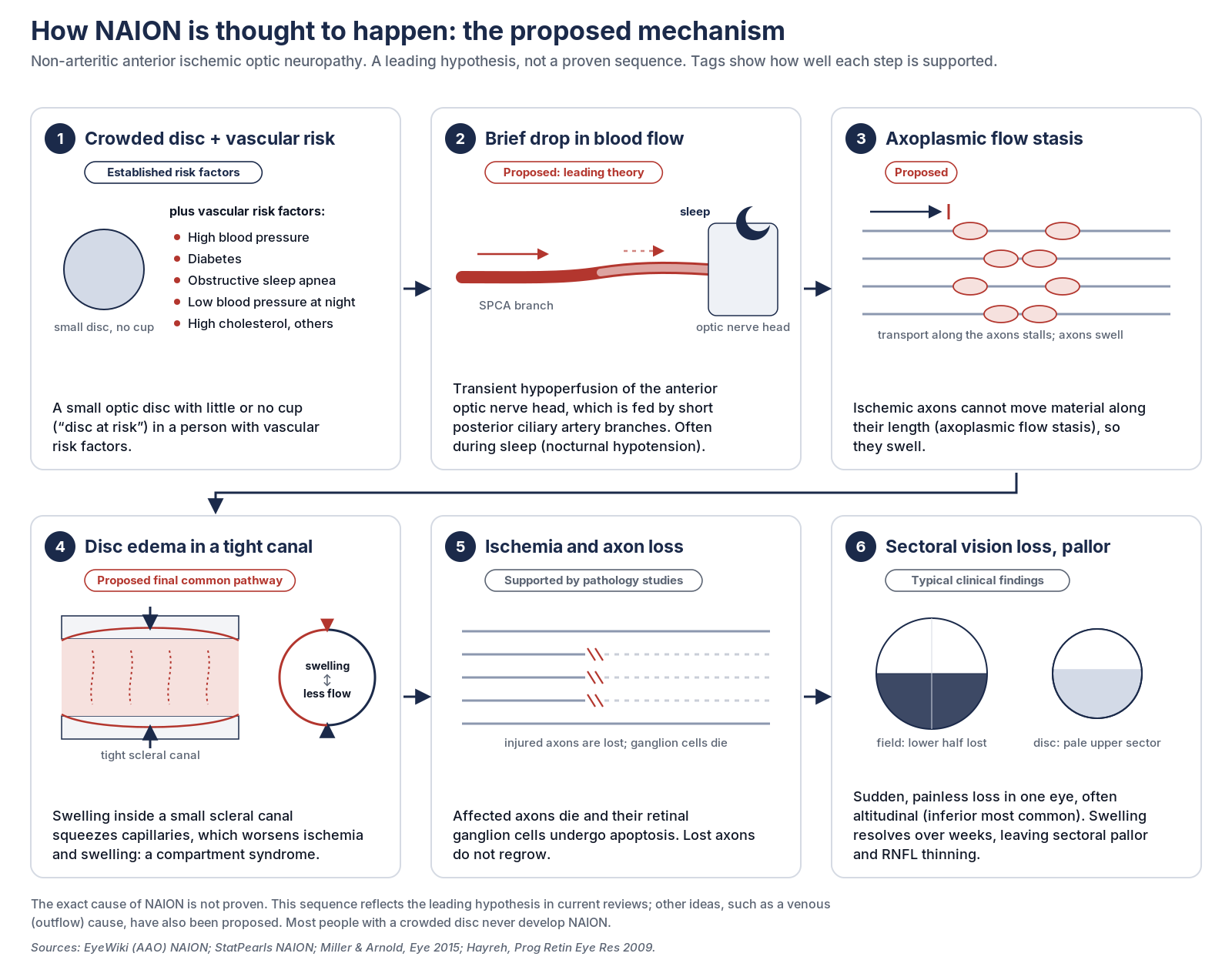
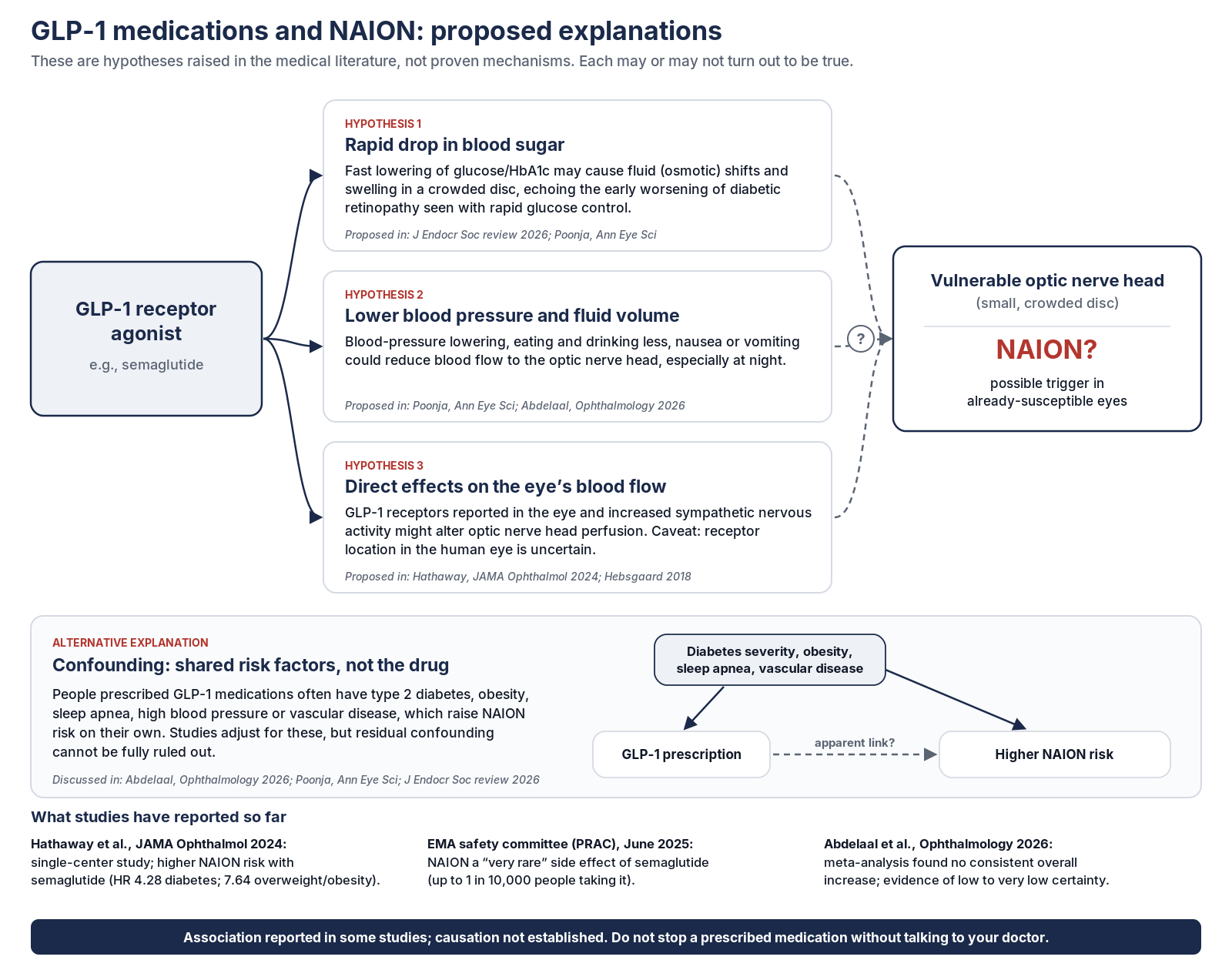
- Transient optic nerve head hypoperfusion from blood pressure lowering, volume depletion (GI losses), or autonomic effects
- Rapid glycemic correction, analogous to early worsening of diabetic retinopathy. Noh et al. found higher relative risk with an A1c drop of 1% or more.¹⁰
- Underlying crowded-disc anatomy may make some patients susceptible.
- The FDA’s review of animal data did not identify a mechanism.¹
Evidence table
A fuller comparison — including null studies, areas of agreement and disagreement, and professional-society positions — is on the study comparison page. The table below remains a compact clinical reference. | Study | Population / comparator | Key result | Notes | |—|—|—|—| | Hathaway, JAMA Ophthalmol 2024¹¹ | Neuro-ophthalmology referral cohort | T2D: 36-mo cumulative incidence 8.9% vs 1.8%, HR 4.28. Obesity: HR 7.64 | Referral bias likely inflates the estimate | | Grauslund, Int J Retina Vitreous 2024¹² | All Danish T2D (424,152; 106,454 exposed) | HR 2.19; median onset 22.2 mo | Nationwide registry | | Danish–Norwegian, DOM 2025¹³ | T2D, semaglutide vs SGLT-2i | Pooled HR 2.81; IRD +1.41/10,000 PY | Curves diverge around 9 months | | Cai (OHDSI), JAMA Ophthalmol 2025¹⁴ | 14 databases, 810,390 new semaglutide users | Cohort HRs not significant in 5 of 6 comparisons; HR 2.27 only vs empagliflozin (specific definition); SCCS IRR 1.32 | A modest signal overall | | JAMA Netw Open 2025¹⁶ | T2D, semaglutide or tirzepatide vs other agents | HR 1.76 (1.01–3.07); 0.04% vs 0.02% at 2 yr | Agents combined | | Abbass et al., AJO 2025¹⁷ | T2D and high BMI, matched TriNetX | No increased risk (5-yr NAION 0.065% in T2D on semaglutide) | Null | | Chou et al., Ophthalmology 2024¹⁷a | Multinational EHR, PSM; T2D, obesity, or both | No significant association at 1, 2, or 3 years in any group | Some CIs are wide; a modest increase is not excluded | | Lieberman et al., Mil Med. 2026¹⁷b | U.S. Military Health System, 1.21 million adults | T2D: adjusted OR 0.36 (0.25–0.51); overweight/obesity NS | Unexpected direction; confounding likely. Not evidence of a protective effect. Cited by AAO/NANOS. | | McDonald and Fung, JAMA Ophthalmol. 2025¹⁵ | Medicare ≥65 T2D (research letter) | Semaglutide HR 1.39 (1.13–1.72) vs other 2nd-line agents | Claims/ICD codes; older adults only | | Noh, Diabetes Care 2026¹⁰ | UK CPRD T2D, GLP-1 RA vs DPP-4i | 18.5 vs 7.2/100,000 at 1 yr; RR 2.56; RD 11.3/100,000; highest in first 6 mo | Higher with age <50, men, ever-smokers, A1c drop ≥1% | | Chrzanowski, PLoS Med 2026² | Meta-analysis, 5 studies, T2D | HR 2.17; vs SGLT-2i 1.96; absolute 0.014%/yr | GRADE low certainty | | Dhivagaran, Neurology 2026¹⁸ | Bayesian meta-analysis | Semaglutide RR 2.52; diabetes 2.41 | Low-to-moderate certainty | | Lampsas, Graefe’s 2026¹⁹ | Meta-analysis, T2D | HR 3.36 at 1 yr; 2.37 at 2–5 yr | | | Ophthalmology meta-analysis 2026²⁰ | 6 observational studies | Pooled aHR 1.63 (0.88–2.39), not significant; T2D 1.70; obesity 0.47 | Fragile, very low to low certainty | | Ueda, Ann Intern Med 2026³ | Sweden T2D, GLP-1 RA vs SGLT-2i | 1-yr 0.04% vs 0.02%, RR 1.93; attenuated in metformin users | Suggests residual confounding | | Sun, DOM 2026²¹ | Network meta-analysis + FAERS | Semaglutide HR 1.54, liraglutide HR 1.25 vs non-GLP-1RA | [Unverified: James’s draft says dulaglutide, exenatide, and tirzepatide were not significant. Confirm from the full text.] | | FDA, Nov 2026¹ | 126 RCTs; Sentinel T2D cohort | 6.4 vs 3.8/100,000 PY (15 events). Sentinel HR 1.43 vs DPP-4i; 1.19 (NS) vs SGLT-2i | Basis of the class labeling change |
Study populations, follow-up, NAION definitions (ICD codes vs adjudicated), and comparators differ. Interpret relative and absolute figures within each study, and don’t pool them into a personal prediction. For a narrative of where these studies agree (absolute risk is small; causation is unproven; semaglutide in type 2 diabetes is the most studied setting) and disagree (magnitude, diabetes vs obesity, tirzepatide and other agents, confounding, and timing), see the study comparison page.
Guidance landscape (where it agrees and where it doesn’t)
| Topic | FDA (Nov 2026)¹ | EMA (Jun 2025)²² | AAO/NANOS (2026)²³ | AOA (Jun 2025)²⁴ |
|---|---|---|---|---|
| Scope | All GLP-1 RAs | Semaglutide | GLP-1 RAs, mainly semaglutide | GLP-1 RAs |
| Baseline exam | Not specified | Not specified | Not recommended solely for NAION risk; continue diabetic exams | Dilated exam within 12 mo before or 1 mo after starting |
| After NAION | Consider discontinuing unless benefits clearly outweigh risk | Stop semaglutide | Shared decision-making; no blanket discontinuation | Clinical report: discontinue and consult the health care team immediately |
Diabetic retinopathy (separate from NAION). An AAO statement (November 2026, Board approval October 2026) recommends an initial period of increased monitoring for diabetic retinopathy in patients with diabetes who start a GLP-1 RA, particularly if baseline A1c has been poorly controlled. The evidence that GLP-1 RAs themselves worsen retinopathy is mixed and not conclusive; if early worsening occurs, it may reflect rapid glycemic improvement. Shared decision-making with the medical team is advised.²⁵
Dr. Deom’s recommendation (clinical opinion / practice recommendation)
Dr. James Deom recommends that everyone starting or taking a GLP-1 medication have a comprehensive dilated eye exam with OCT, OCT angiography (OCTA), and retinal photography (fundus photos with autofluorescence) as a baseline and for follow-up, and seek same-day care for sudden vision loss.
This is his clinical opinion and practice recommendation, labeled separately from the society table above. He agrees with AAO/NANOS that no exam or imaging test reliably predicts or prevents NAION, and that exams should not be described as a NAION screening test.
Why he recommends each test — for documentation, not for prediction:
- OCT: a baseline measure of retinal nerve fiber layer (RNFL) and ganglion-cell layer (GCL) thickness, and of optic disc structure, to compare against if vision changes later.
- OCT angiography (OCTA): a baseline record of peripapillary, optic nerve head, and macular perfusion.
- Fundus photographs with autofluorescence: a baseline record of disc appearance, crowding, possible optic disc drusen, and retinal disease.
These tests do not reliably predict or prevent NAION. AAO and NANOS do not recommend a routine exam solely to predict NAION, and this site does not describe this imaging set as a NAION screening test. Dr. Deom still recommends it as a practice approach so that a baseline exists, other eye disease can be found, and disc anatomy is documented.
His practice approach is a baseline exam with this imaging set before starting or soon after (a practical window is within 12 months before or 1 month after, consistent with AOA timing), a repeat exam with the same imaging at a reasonable interval individualized to the findings, and same-day evaluation for sudden monocular vision loss. See the monitoring framework. This is more proactive than the AAO/NANOS position against exams performed solely to assess NAION risk.
Dr. James Deom’s personal clinical thought
This is his opinion, not established evidence. It is not a finding from the studies or a position of the FDA, EMA, AAO, NANOS, or AOA.
As patients lose weight and their overall health improves on GLP-1 medicines, blood pressure and cholesterol medicines are often not re-addressed. Over-treatment of blood pressure may lead to hypotension, which can worsen at night and could cause nighttime hypoperfusion of the optic nerve. That sequence would fit the typical presentation of NAION (vision loss noticed on waking).
He recommends that people on GLP-1 medicines also improve exercise and diet, and keep regular visits with their usual doctors, even if that clinician did not prescribe the GLP-1, so the rest of their care, including blood pressure, is maintained.
For prescribers: consider reviewing antihypertensive dosing and timing (including bedtime dosing) as weight drops. Coordinate changes with the patient’s usual clinician when someone else wrote the GLP-1 prescription.
Practice capability: all five Eye Specialists of NEPA / Hazleton Eye Specialists offices (Hazleton, Stroudsburg, Nanticoke, Pottsville, and Bangor) have OCT, OCT angiography (OCTA), and fundus photography with autofluorescence.
Exam considerations
Proposed framework. See the full table at Monitoring framework.
Identify patients who need closer assessment: – Prior NAION in either eye, or any optic neuropathy – Crowded disc, small C/D, or optic disc drusen (consider EDI-OCT or B-scan/autofluorescence in younger patients or atypical discs) – RVO or a hypercoagulable state – Diabetic retinopathy, especially when a rapid A1c drop is expected – Several systemic factors: age over 50, male sex, smoking, hypertension, complicated diabetes, untreated or suspected OSA, hyperlipidemia, anemia, bedtime antihypertensives or a history of hypotension
At baseline (Dr. Deom’s practice recommendation for every patient starting or taking a GLP-1 RA): – Visual acuity, pupils (RAPD), color vision as indicated – Dilated optic nerve evaluation with C/D and disc morphology – OCT (RNFL / GCL / ONH), OCT angiography (peripapillary, optic nerve head, and macular perfusion), and disc and retinal photography with autofluorescence, to document a baseline for later comparison and to look for crowded discs, disc drusen, and retinal disease. These tests do not reliably predict or prevent NAION. – Visual fields if the disc is abnormal, symptoms are present, or there is prior NAION – Retinal staging for diabetic patients
Patients who need closer assessment may need earlier or more frequent repeat imaging and fields, as outlined in the monitoring framework.
Important limitation: OCT, OCTA, photos, and fields help characterize existing findings and document change. They do not reliably predict or prevent an acute NAION event.
Acute presentation (suspected NAION on a GLP-1 RA): – Same-day evaluation: acuity, RAPD, fields, dilated exam of both discs, OCT RNFL/GCL, OCTA, and photos as clinically indicated – Exclude GCA when age is over 50 or symptoms suggest it (ESR, CRP, CBC with platelets; coordinate temporal artery biopsy or ultrasound as indicated) – Consider atypical features (pain with eye movement, bilateral involvement, progression past about 2 weeks, a non-crowded fellow disc, young age) that call for neuro-imaging or neuro-ophthalmology – Contact the prescriber the same day – Report to FDA MedWatch¹
Documentation checklist
- [ ] GLP-1 RA agent, dose, start date, and recent titration
- [ ] Indication (T2D, obesity, CV, CKD, OSA, MASH), which matters for the benefit-risk discussion
- [ ] Recent A1c trend and any rapid drop; GI losses; orthostatic symptoms
- [ ] Ocular history: prior NAION or optic neuropathy, drusen, glaucoma, DR stage
- [ ] Systemic risk factors reviewed (OSA/CPAP use, BP and timing of antihypertensives, smoking, anemia, PDE-5i, amiodarone)
- [ ] Baseline disc description, C/D, and OCT/photo/field results with the reason each test was ordered
- [ ] Symptom counseling given (sudden monocular loss means same-day care)
- [ ] Follow-up interval chosen and why
- [ ] Communication sent to the prescriber, and the shared medication decision recorded (if NAION occurs)
Communicating with prescribers
Principles: be brief, quantify the absolute risk, defer the systemic decision to the prescriber and patient, and state the specific ocular findings and what you need from them.
Template: baseline note for a patient with risk features
Dear Dr. ___, I saw your patient ___ on ___ for an eye exam related to [planned / current] [semaglutide/tirzepatide/other]. Findings: [e.g., crowded optic discs OU / optic disc drusen OD / moderate NPDR OU]. Baseline OCT and photos are on file. As you know, the FDA (Nov 2026) added a potential increased risk of NAION to GLP-1 RA labeling. The absolute risk is low (for example, about 1 extra case per 7,000 patients per year with semaglutide in one pooled analysis). Given these findings, I’d suggest [counseling on sudden vision loss / attention to nocturnal hypotension and hydration during titration / gradual A1c lowering with retinal follow-up in ___ months]. I defer the medication decision to you and the patient. Please contact me with any questions. [Name, phone, fax]
Providers can call or text Dr. Deom’s cell at 570-436-1930 for a same-day evaluation. General contact and referrals: Hazleton Eye Specialists, phone 570-453-2020, fax 570-453-1020.
Template: suspected or confirmed NAION
Dear Dr. ___, Your patient ___ presented today with [sudden painless vision loss OD/OS] consistent with NAION. [GCA work-up: ___.] Current VA ___; field defect ___. The FDA recommends considering discontinuation of the GLP-1 RA after NAION unless the benefits clearly outweigh the risk, while AAO/NANOS recommend an individualized, shared decision. The fellow-eye risk is a key consideration. I’d welcome a conversation about the patient’s systemic indication and alternatives. [Also addressing: OSA evaluation / BP timing / anemia.] I have reported this case to FDA MedWatch. Follow-up here in ___.
Medical disclaimer. This page is educational and intended for licensed eye-care professionals. It is not a clinical practice guideline and does not replace clinical judgment, product labeling, or specialty consultation. Recommendations from regulators and professional societies differ and continue to evolve. Information is current as of the “last reviewed” date.
References
- U.S. FDA Drug Safety Communication, Nov 9, 2026. https://www.fda.gov/drugs/drug-safety-communications/fda-requires-safety-labeling-changes-glucagon-peptide-1-receptor-agonists-glp-1-ras-due-potential
- Chrzanowski J, et al. PLoS Med. 2026;23(5):e1005064. https://journals.plos.org/plosmedicine/article?id=10.1371/journal.pmed.1005064
- Ueda P, et al. Ann Intern Med. 2026;179(9):1232-1243. https://www.acpjournals.org/doi/10.7326/ANNALS-25-02096
- Biousse V, Newman NJ. Ischemic optic neuropathies. N Engl J Med. 2015;372:2428-2436.
- Biousse V, Newman NJ. Diagnosis and clinical features of common optic neuropathies. Lancet Neurol. 2016;15(13):1355-1367.
- Cestari DM, et al. Ophthalmology. 2016. https://pubmed.ncbi.nlm.nih.gov/27659545/
- Liu B, et al. Front Med. 2021;8:618353. https://www.frontiersin.org/journals/medicine/articles/10.3389/fmed.2021.618353/full
- OSA and NAION, Korean cohort. Br J Ophthalmol. 2019;103(8):1123. https://bjo.bmj.com/content/103/8/1123
- Gabbay et al. PLoS One. 2024. https://journals.plos.org/plosone/article?id=10.1371/journal.pone.0313098
- Noh Y, et al. Diabetes Care. 2026;49(5):763-771. https://diabetesjournals.org/care/article/49/5/763/164499/
- Hathaway JT, et al. JAMA Ophthalmol. 2024;142(8):732-739. https://jamanetwork.com/journals/jamaophthalmology/fullarticle/2820255
- Grauslund J, et al. Int J Retina Vitreous. 2024. https://link.springer.com/article/10.1186/s40942-024-00620-x
- Danish–Norwegian cohort. Diabetes Obes Metab. 2025;27(6):3094-3103. https://pubmed.ncbi.nlm.nih.gov/40098249/
- Cai CX, et al. JAMA Ophthalmol. 2025. https://jamanetwork.com/journals/jamaophthalmology/fullarticle/2830475
- McDonald CJ, Fung KW. GLP-1 RAs and risk of NAION in older patients with diabetes. JAMA Ophthalmol. 2025. https://jamanetwork.com/journals/jamaophthalmology/fullarticle/2836771
- JAMA Netw Open. 2025. https://jamanetwork.com/journals/jamanetworkopen/fullarticle/2837377
- Abbass NJ, et al. Am J Ophthalmol. 2025. https://www.ajo.com/article/S0002-9394(25)00094-7/fulltext 17a. Chou CC, et al. Association between semaglutide and NAION. Ophthalmology. 2024. https://www.aaojournal.org/article/S0161-6420(24)00685-7/fulltext 17b. Lieberman RA, et al. Mil Med. 2026;191(5-6):e1020. https://academic.oup.com/milmed/article/191/5-6/e1020/8320596
- Dhivagaran T, et al. Neurology. 2026;106(10):e214864. https://www.neurology.org/doi/10.1212/WNL.0000000000214864
- Lampsas S, et al. Graefes Arch Clin Exp Ophthalmol. 2026. https://doi.org/10.1007/s00417-026-07291-4
- Ophthalmology. 2026. https://www.aaojournal.org/article/S0161-6420(26)00082-5/fulltext
- Sun et al. Diabetes Obes Metab. 2026. https://doi.org/10.1111/dom.71358
- EMA PRAC, Jun 6, 2025. https://www.ema.europa.eu/en/news/prac-concludes-eye-condition-naion-very-rare-side-effect-semaglutide-medicines-ozempic-rybelsus-wegovy
- AAO & NANOS consensus statement: https://www.aao.org/education/clinical-statement/glucagon-like-peptide-1-receptor-agonists-risk-of- · release, Sep 22, 2026: https://www.aao.org/newsroom/news-releases/detail/what-data-say-about-glp-1-drugs-vision-loss
- AOA clinical report, June 2025. https://www.aoa.org/AOA/Documents/Practice%20Management/Clinical%20Guidelines/AOA%20GLP-1_EBO_clinical-report.pdf
- American Academy of Ophthalmology. GLP-1 receptor agonists and diabetic retinopathy: a statement from the American Academy of Ophthalmology. November 2026. https://www.aao.org/education/clinical-statement/glucagon-like-peptide-1-receptor-agonists-diabetic