NAION risk factors
Understanding optic nerve health and your individual care plan
Sudden vision loss in one eye needs same-day care. See the warning signs at the end of this page.
What NAION means
NAION (non-arteritic anterior ischemic optic neuropathy) is sometimes called a “stroke of the optic nerve.” Blood flow to the front of the nerve drops, the nerve swells, and part of the vision in one eye is lost, usually suddenly and painlessly, and often noticed on waking. It is uncommon: about 2 to 10 of every 100,000 adults over 50 each year.¹
How to use this guide
A risk factor makes NAION more likely. It does not mean you will get it, and most people with these factors never do. “1.5 times the risk” means a 50% relative increase. Because NAION is uncommon, even a higher relative risk can still mean a small real-world chance. For each factor, we explain what it is, how strong the link is, whether it can be changed, and what to discuss with your care team.
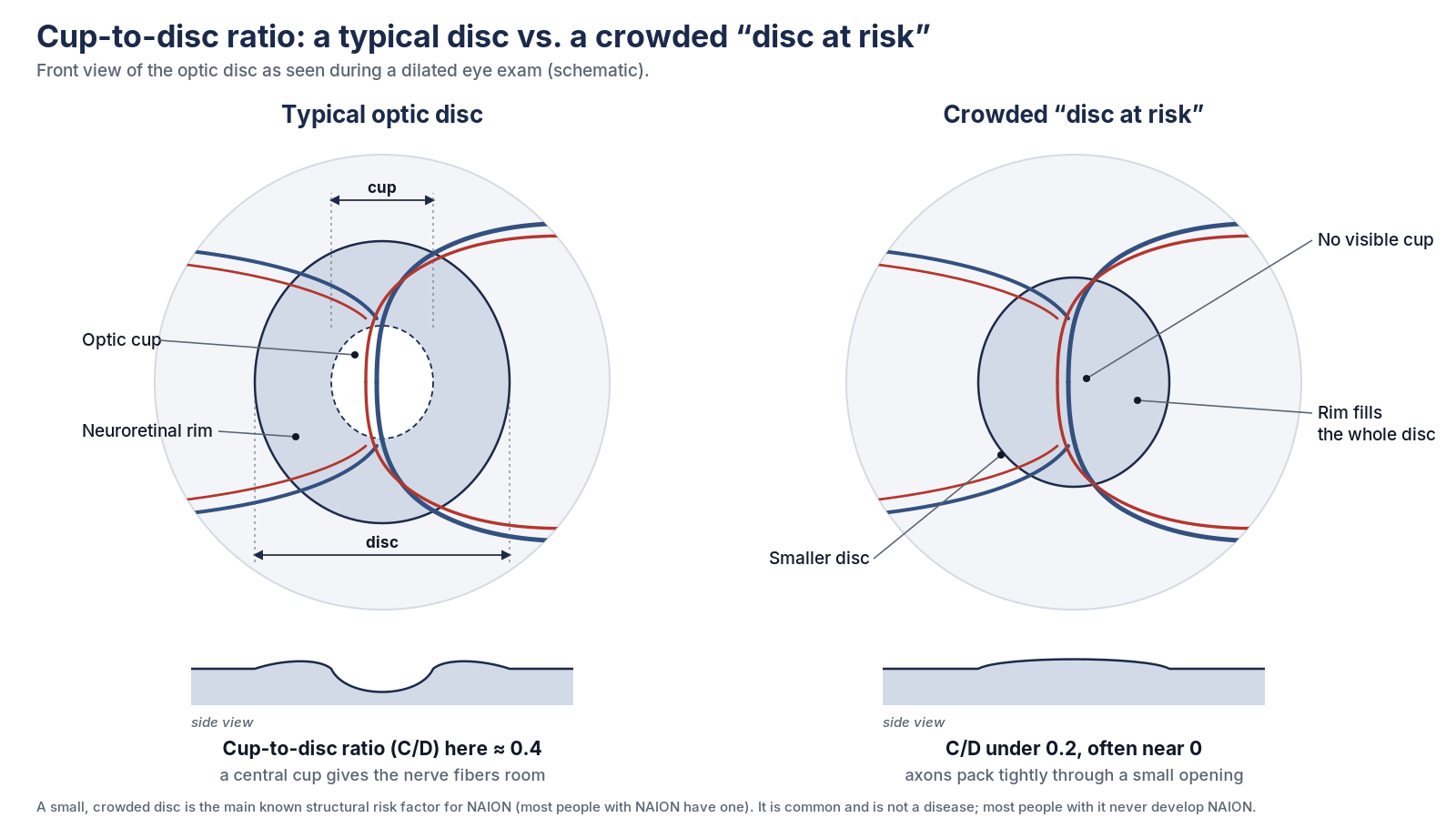
1. A crowded optic nerve (“disc at risk”)
What it is: Some optic nerves have a small central cup and tightly packed fibers, leaving little room for swelling. Your eye doctor can see this during an exam. Strength of link: A crowded disc is the main anatomic risk factor.² Most people with it never develop NAION. Can it be changed? No, you’re born with it. What you can do: Ask your eye doctor whether you have a crowded disc. You can’t feel it; it is seen during an exam. If you do, focus on the factors below that can be changed, and know the warning signs.
2. Optic disc drusen
What it is: Small deposits within the optic nerve head that can crowd nerve fibers. OCT imaging can help find them. (PHOMS, another OCT finding, is not the same thing.) Strength of link: Strong in younger adults with NAION. Two 2020 studies of people 50 and under with NAION found drusen in about 51% and 53% of affected eyes.³ ⁴ These figures describe people who already had NAION. They do not mean half of people with drusen will develop it. Can it be changed? No, but it can be found. What you can do: If you’re under 50, or your optic nerve looks unusual, ask whether an OCT scan makes sense.
3. Obstructive sleep apnea
What it is: The airway repeatedly closes during sleep, so oxygen drops and blood pressure swings. Signs include loud snoring, pauses in breathing, gasping, morning headaches, and daytime sleepiness. Strength of link: Strong, and one of the most consistent findings. – Pooled studies found NAION about 3 times as likely in people with sleep apnea.⁵ – A Korean national study compared 919 people with newly diagnosed sleep apnea to 9,190 similar people. Over about 10 years, 0.92% vs 0.42% developed NAION, an adjusted risk about 3.8 times higher.⁶ – In a small French study of 89 people who had already had NAION and had severe sleep apnea, not using prescribed CPAP was linked to about 5.5 times the risk of NAION in the second eye.⁷ This does not prove that CPAP prevents NAION. Can it be changed? Yes. It’s one of the most treatable factors. What you can do: Tell your doctor about snoring, breathing pauses, or daytime tiredness, and ask about a sleep study. If you’re prescribed CPAP, use it every night.
4. High blood pressure
Strength of link: Moderate. Large reviews found about 1.3 to 1.5 times the odds,⁵ ⁸ and one large U.S. study found about 1.6 times.⁹ Many people with NAION have high blood pressure. Can it be changed? Yes. What you can do: Take blood pressure medicines as prescribed, check at home if your doctor suggests it, limit salt and alcohol, and stay active.
5. Low blood pressure at night
What it is: Blood pressure normally dips during sleep. In some people it may dip too far, which may reduce blood flow to the optic nerve, and this may help explain why NAION is often noticed on waking. Strength of link: Possible. The evidence comes from smaller studies, and experts still debate it. What you can do: Don’t change when you take your blood pressure medicine on your own. If you have a crowded disc or have had NAION, ask the prescribing clinician to review your blood pressure pattern and timing. Tell your doctor if you feel dizzy or lightheaded, especially at night or on standing.
6. Diabetes
Strength of link: Moderate. Reviews found about 1.5 to 1.7 times the odds.⁵ ⁸ ¹⁰ Diabetes is present in up to about 1 in 4 people with NAION. What you can do: Work with your care team on blood sugar goals and keep regular diabetic eye exams. If you’re starting a medicine that can lower blood sugar a lot, ask how to coordinate diabetes treatment and eye follow-up. A rapid drop in A1c can temporarily worsen diabetic retinopathy in some people. Whether it plays a role in NAION is still uncertain.
7. High cholesterol and other blood fats
Strength of link: Moderate. High cholesterol or abnormal blood fats are linked to about 1.4 to 2 times the odds.⁵ ⁸ High lipoprotein(a) was linked to about 2.9 times the odds in a small number of studies, so that estimate is less certain.⁸ What you can do: Get your cholesterol checked, eat heart-healthy, and take cholesterol medicine if prescribed. (Lipoprotein(a) is mostly inherited.)
8. Heart disease and hardened arteries
Strength of link: Moderate. Coronary heart disease is linked to about 1.7 times the odds.⁵ NAION is not caused by a clot traveling to the eye, and having NAION doesn’t mean you’re about to have a stroke. What you can do: Follow your heart treatment plan and keep your cardiology visits.
9. Smoking
Strength of link: Linked in several studies. The size of the risk is less certain. What you can do: Quitting helps your eyes, heart, and brain. Ask about medicines and programs that help.
10. Age and sex
Men have about 1.5 to 1.7 times the risk of women.⁵ ⁹ NAION is most common after 50. Can it be changed? No, so it’s even more worthwhile to work on the factors you can change.
11. Blood-clotting disorders
Strength of link: Factor V Leiden is linked to about 2.2 times the risk,⁵ and clotting disorders overall to about 2.5 times in one large U.S. study.⁹ These are rare causes of NAION overall. What you can do: Testing is usually done only in special situations, such as NAION at a young age without other risk factors, NAION in both eyes, NAION that comes back, or a family history of clotting problems.
12. Low blood flow or low blood count
Anything that suddenly lowers blood pressure or blood flow can trigger NAION, especially in a crowded disc. Examples include major blood loss, severe anemia, dehydration (including from vomiting or diarrhea), heart failure, shock, and big blood pressure swings during dialysis. This is supported by a large nationwide study¹¹ and many case reports. What you can do: Follow your care team’s fluid advice, especially when sick (or your fluid limit if you have one). Have possible anemia checked. Tell your surgeon or dialysis team if you have a crowded disc or have had NAION.
13. Eye conditions and procedures
A sudden rise in eye pressure, for example after cataract surgery, with acute angle-closure glaucoma, or after eye injections, has been linked to NAION in case reports. The overall risk is low. What you can do: If you’ve had NAION in one eye, mention it to your eye surgeon before any procedure.
14. Migraine
Listed as a possible risk factor, but the evidence is limited. Some migraine medicines narrow blood vessels, so tell your doctor if you have a crowded disc or have had NAION.
15. Medicines
Several medicines have been linked to NAION. In most people who developed NAION while taking one, other risk factors were also present, so it’s hard to prove the medicine was the cause. – GLP-1 medicines (semaglutide/Ozempic, Wegovy, Rybelsus; liraglutide; dulaglutide; tirzepatide/Mounjaro, Zepbound; and others): On Nov 9, 2026, the FDA required a class-wide label warning about a potential increased risk.¹ Research results are mixed. Several studies found about 2 times the risk with semaglutide,¹² ¹³ while others found little or no added risk once diabetes severity was taken into account.¹⁴ One 2026 review estimated about 1 extra case per 7,000 people taking semaglutide for a year.¹² That estimate doesn’t apply equally to every medicine or every person. See GLP-1 medicines and your eyes. – Erectile dysfunction medicines (PDE-5 inhibitors such as sildenafil and tadalafil) – Amiodarone (a heart-rhythm medicine) – Medicines that narrow blood vessels, such as decongestants and hospital vasopressors – Some blood pressure and heart medicines, especially if pressure drops too low at night
What you can do: Never stop or change a medicine on your own. Discuss benefits and risks with your prescriber. If you have a crowded disc or drusen, or have had NAION, mention it before starting any of these.
Warning signs that need same-day care
Seek immediate, same-day care from an eye doctor or an emergency department for: – sudden loss or dimming of vision in one eye, often noticed on waking – a dark shadow or missing area, often the top or bottom half of your vision – colors that look washed out in one eye
If you’re over 50 and also have a new headache, scalp tenderness, jaw pain when chewing, fever, or weight loss, get help right away. These can be signs of giant cell arteritis, an emergency that needs treatment the same day to protect the other eye.
Risk factors at a glance
| Risk factor | Reported association | Can it be addressed? |
|---|---|---|
| Crowded optic disc | Main anatomic factor | Anatomy can’t be changed |
| Optic disc drusen | Strong in younger adults with NAION | Can be found and monitored |
| Sleep apnea | About 3–4× in studies | Sleep testing and treatment |
| High cholesterol / blood fats | About 1.4–2× | Yes |
| Diabetes | About 1.5–1.7× | Yes, with blood sugar control |
| Heart disease | About 1.7× | Managed |
| High blood pressure | About 1.3–1.6× | Yes |
| Low blood pressure at night | Possible; debated | Review with prescriber |
| Smoking | Linked | Yes, by quitting |
| Clotting disorders | About 2–2.5× (rare) | Managed |
| Low blood flow or anemia | Linked | Often |
| Certain medicines | Varies by medicine and study | Individual discussion with prescriber |
| Male sex, older age | About 1.5–1.7× (male) | No |
Steps to discuss with your care team
- Know your optic nerve. Ask for a dilated exam, whether you have a crowded disc or drusen, and whether OCT would help.
- Get checked for sleep apnea if you snore or are tired during the day. Use CPAP if prescribed.
- Control blood pressure, blood sugar, and cholesterol, and ask about avoiding very low blood pressure at night.
- Don’t smoke.
- Follow your clinician’s fluid advice, especially when you’re sick or starting a medicine that can cause vomiting or diarrhea.
- Tell every doctor if you have a crowded disc or have had NAION, especially before surgery or a new medicine.
No treatment or screening schedule has been proven to prevent NAION. These steps support your overall health and help your care team address related conditions, but their benefit for preventing NAION is uncertain.
If you take, or are starting, a GLP-1 medicine
Dr. James Deom recommends that everyone starting or taking a GLP-1 medication have a comprehensive dilated eye exam with OCT, OCT angiography (OCTA), and retinal photography (fundus photos with autofluorescence) as a baseline and for follow-up, and seek same-day care for sudden vision loss.
This is his clinical opinion and practice recommendation. The American Optometric Association recommends an exam within 12 months before starting or within one month after.¹⁶ Eye-specialist groups (AAO and NANOS) do not recommend an exam solely to try to predict NAION, and no exam or imaging test has been shown to predict or prevent it.¹⁵ He still recommends this exam and imaging to document a baseline (OCT for nerve-fiber and ganglion-cell thickness and disc structure; OCTA for blood flow around the optic nerve and macula; photographs with autofluorescence for disc appearance, crowding, possible disc drusen, and retinal disease), not as a test that can predict NAION. A comparison of the major studies and the GLP-1 patient page have more detail.
Dr. James Deom’s personal clinical thought
This is his opinion, not established evidence. It is not a finding from the studies or a position of the FDA, EMA, AAO, NANOS, or AOA.
As people lose weight and get healthier on GLP-1 medicines, their blood pressure and cholesterol medicines are often not reviewed or adjusted. Blood pressure treatment that is no longer matched to a person’s needs may lead to low blood pressure (hypotension). Low blood pressure can be more pronounced at night and could reduce blood flow to the optic nerve during sleep. That possibility would fit the typical way NAION presents: vision loss noticed on waking.
Dr. Deom recommends that people taking a GLP-1 medicine also work on exercise and diet, and keep regular visits with their usual doctors — even if that doctor did not prescribe the GLP-1 — so the rest of their care, including blood pressure, is maintained. Do not start, stop, or change a blood pressure or cholesterol medicine on your own; talk with the clinician who prescribes it.
All five offices have OCT, OCT angiography, and fundus photography with autofluorescence. If you are starting or taking a GLP-1 medicine, you can request that exam and imaging; the offices offer priority scheduling for this visit. See the GLP-1 patient page for common questions.
- Hazleton Eye Specialists: 281 Airport Road, Hazle Township, PA 18202 · 570-453-2020
- Stroudsburg Eye Specialists: 2942 Route 611, Suite 5, Tannersville, PA 18372 · 570-421-3342
- Nanticoke Eye Specialists: 233 S. Prospect St., Nanticoke, PA 18634 · 570-735-6000
- Pottsville Eye Specialists: 541 West Bacon Street, Pottsville, PA 17901 · 570-628-3937
- Bangor Eye Specialists: 385 Bangor Junction Rd., Bangor, PA 18013 · 610-588-0129
Medical disclaimer. This page is for general education only. It is not medical advice and does not replace an examination or a conversation with your own doctors. Do not start, stop, or change any medicine without talking to the clinician who prescribes it. If you have sudden vision loss, seek same-day care from an eye doctor or an emergency department. Information is current as of the “last reviewed” date and may change as new research is published.
References
- U.S. FDA Drug Safety Communication, Nov 9, 2026. https://www.fda.gov/drugs/drug-safety-communications/fda-requires-safety-labeling-changes-glucagon-peptide-1-receptor-agonists-glp-1-ras-due-potential
- Biousse V, Newman NJ. Ischemic optic neuropathies. N Engl J Med. 2015;372:2428-2436.
- Young adults with anterior ischemic optic neuropathy: a multicenter optic disc drusen study. Am J Ophthalmol. 2020. https://doi.org/10.1016/j.ajo.2020.03.052
- Prevalence of optic disc drusen in young patients with NAION: a 10-year retrospective study. J Neuroophthalmol. 2020. https://doi.org/10.1097/wno.0000000000000974
- Liu B, et al. Risk factors for NAION: a large scale meta-analysis. Front Med. 2021;8:618353. https://www.frontiersin.org/journals/medicine/articles/10.3389/fmed.2021.618353/full
- Obstructive sleep apnoea and increased risk of NAION (Korean national cohort). Br J Ophthalmol. 2019;103(8):1123. https://bjo.bmj.com/content/103/8/1123
- Aptel F, et al. Association of NAION with obstructive sleep apnea syndrome. JAMA Ophthalmol. 2015. https://jamanetwork.com/journals/jamaophthalmology/fullarticle/2276934
- Cardiometabolic factors and risk of NAION: systematic review and meta-analysis. Graefes Arch Clin Exp Ophthalmol. 2022. https://pubmed.ncbi.nlm.nih.gov/35067769/
- Cestari DM, et al. Demographic, systemic, and ocular factors associated with NAION. Ophthalmology. 2016. https://pubmed.ncbi.nlm.nih.gov/27659545/
- Chen T, et al. Diabetes mellitus and NAION: systematic review and meta-analysis. PLoS One. 2013. https://journals.plos.org/plosone/article?id=10.1371/journal.pone.0076653
- Gabbay et al. Hypoperfusion states could increase the risk of NAION. PLoS One. 2024. https://journals.plos.org/plosone/article?id=10.1371/journal.pone.0313098
- Chrzanowski J, et al. PLoS Med. 2026;23(5):e1005064. https://journals.plos.org/plosmedicine/article?id=10.1371/journal.pmed.1005064
- Danish–Norwegian cohort study. Diabetes Obes Metab. 2025;27(6):3094-3103. https://pubmed.ncbi.nlm.nih.gov/40098249/
- Ueda P, et al. Ann Intern Med. 2026;179(9):1232-1243. https://www.acpjournals.org/doi/10.7326/ANNALS-25-02096
- American Academy of Ophthalmology & NANOS, Sep 22, 2026. https://www.aao.org/newsroom/news-releases/detail/what-data-say-about-glp-1-drugs-vision-loss
- American Optometric Association. GLP-1 medications and your vision. https://www.aoa.org/healthy-eyes/caring-for-your-eyes/glp-1-medications-and-your-vision